15 Powerful Natural Ventilation Strategies for Small Houses (Stay Cool Without AC)
- Gourav

- Jan 7
- 2 min read
Updated: Mar 18

Introduction
Small House ≠ Easy Cooling
Here’s the flawed assumption:“Small houses are easier to cool.”
👉 Wrong.
Small houses:
Heat up faster
Have limited airflow paths
Often suffer from poor window placement
So ventilation must be intentional, not incidental.
The Core Principle: Air Must Flow, Not Just Enter
Ventilation fails when:
Air enters but doesn’t exit
Openings are misaligned
Internal partitions block flow
Think of airflow as a continuous path, not random openings.
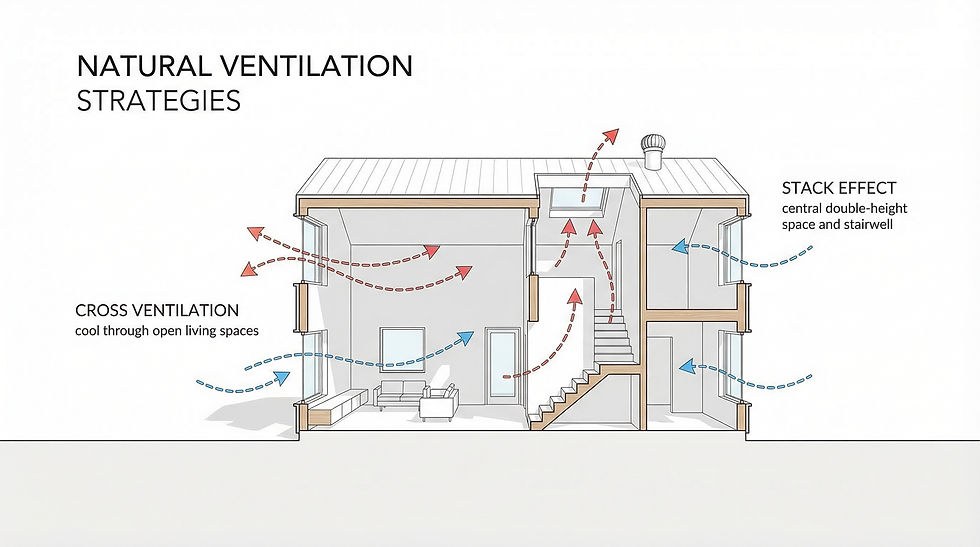
1. Cross Ventilation (Non-Negotiable)
Strategy: Openings on opposite walls
Why it works:
Creates pressure difference
Forces air movement through the space
Pro Insight:
Even a small house can achieve strong airflow if:
Openings are aligned
Furniture doesn’t block air
2. Stack Ventilation (Use Hot Air Physics)
Hot air rises. Use it.
How:
Install high-level vents or clerestory windows
Use double-height or sloped ceilings
Add roof ventilators
This pulls cooler air from below and pushes hot air out.
3. Window Placement Strategy (Not Just Size)
Key Rules:
Place windows at different heights
Use operable windows (casement > sliding)
Align with wind direction
Bigger windows don’t guarantee better airflow—placement does.
4. Open Plan Layout (Remove Air Barriers)
Small houses often fail because of too many partitions.
Fix:
Use semi-open layouts
Replace walls with perforated partitions or screens
Air behaves like water—it follows the easiest path.
5. Courtyard or Lightwell (Even in Tiny Homes)
Even a 1–1.5m wide void can:
Improve airflow
Bring daylight
Create a cooling microclimate
This is a high-impact strategy most small homes ignore.
6. External Shading (Prevents Heat Before Ventilation)
Ventilation alone won’t work if heat gain is high.
Use:
Overhangs
Louvers
Trees or vertical greenery
Less heat inside = less need for airflow correction.
7. Breathable Materials
Smart Materials:
Perforated brick (jaali)
Ventilation blocks
Bamboo screens
These allow continuous airflow without compromising privacy.
8. Door Positioning Matters
Doors are often ignored in ventilation design.
Strategy:
Align doors with windows
Use louvered doors where possible
Every opening contributes to airflow—not just windows.
9. Roof Ventilation (Critical for Small Houses)
Roof = biggest heat source.
Solutions:
Ventilated roof cavity
Ridge vents
Double roof system
Without this, heat gets trapped and radiates downward.
⚠️ Common Mistakes (Brutal Truth)
❌ “One window per room is enough”
→ That’s ventilation failure.
❌ “Privacy over airflow”
→ Results in stagnant, hot interiors.
❌ “Fans replace ventilation”
→ Fans move hot air—they don’t remove it.
Advanced Strategies (Top 1% Design Thinking)
1. Wind Catchers (Traditional, Highly Effective)
Captures wind and directs it inside
2. Split-Level Floors
Enhances vertical air movement
3. Smart Landscaping
Grass + water bodies cool incoming air
These create micro-climate advantages, not just airflow.

Conclusion
Natural ventilation in small houses is not about adding more openings—it’s about designing a complete airflow system:
Entry → Movement → Exit
If you control this path, you control comfort. Whether you’re planning a new home or optimizing an existing design, Graphite can help you reduce costs, improve performance, and make smarter architectural decisions from the start.
Reach out to Graphite to explore how your project can be designed better, built smarter, and perform efficiently over time.Fill out the form here


Comments