Best House Orientation for Hot Climates (Complete Guide)
- Gourav

- Jan 5
- 2 min read
Introduction
Designing a house in a hot climate without considering orientation is like building blind. Orientation alone can reduce indoor temperatures by 3–5°C—without any mechanical cooling.
In regions like Bangladesh or Southeast Asia, where heat and humidity dominate, your design decisions must start with one principle:
Control heat gain before you try to remove it.
This guide breaks down orientation strategies using first principles—not vague advice—so you can design homes that stay naturally cool, energy-efficient, and comfortable.

Understanding the Sun Path (Core Principle)
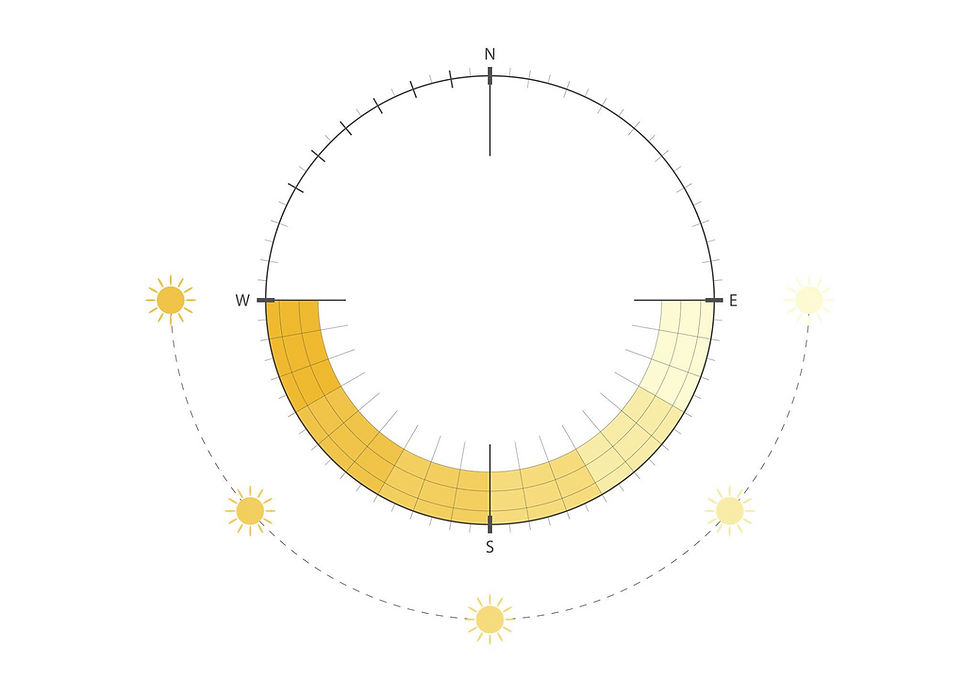

In hot climates, the sun behaves predictably:
East & West sun = harsh, low-angle heat (hard to block)
South sun (in tropics) = high-angle, easier to shade
North side = soft, indirect light (coolest)
👉 Strategic implication:
Minimize east-west exposure
Maximize north-south orientation
Ideal House Orientation (The Golden Rule)
Best Orientation:
Long axis of the building = East–WestMain facades = North & South
Why this works:
Reduces exposure to low-angle east-west sun
Allows easier shading with horizontal devices
Improves daylight quality without overheating
Cross Ventilation: The Real Game Changer
Orientation alone isn’t enough—airflow is your second weapon.
Key Strategies:
Place openings on opposite walls
Align with prevailing wind direction
Use larger inlet + smaller outlet for pressure-driven airflow
Advanced Insight:
Most homes fail because windows are placed for views, not ventilation logic. That’s a design mistake.
👉 Think airflow first, aesthetics second.

Zoning Your Spaces Intelligently
Smart Room Placement:
North Side: Bedrooms, living rooms (cool & comfortable)
South Side: Active spaces (manageable heat)
West Side: Toilets, stairs, storage (heat buffer zone)
East Side: Kitchens (morning sun, less overheating)
👉 This is not random—it’s thermal zoning.
Shading Strategies That Actually Work
Critical Rule:
Not all facades need the same shading.
South: Horizontal overhangs
East/West: Vertical fins or double-skin facade
Roof: Insulation + reflective materials
👉 Biggest mistake: using identical shading on all sides.
Materials & Heat Control
Orientation fails if materials fight against it.
Use:
Light-colored or reflective roofs
High thermal mass walls (delays heat transfer)
Insulated roof slabs
Avoid:
Large unshaded glass surfaces
Dark exterior finishes

⚠️ Common Mistakes (Pressure-Test Your Design)
Let’s challenge typical thinking:
❌ “More glass = better design”
→ In hot climates, it means more heat gain.
❌ “West-facing balcony looks premium”
→ It becomes unusable after 2 PM.
❌ “AC will solve everything”
→ That’s operational cost, not design intelligence.
Advanced Strategies (What Top 1% Designers Do)
If you want to stand out as an architect:
1. Use Courtyard Cooling
Creates stack ventilation
Reduces indoor temperature naturally
2. Introduce Double-Skin Facades
Air gap reduces heat transfer
3. Landscape as Climate Tool
Trees on west side reduce heat drastically
Conclusion
The best house orientation in hot climates is not a rule—it’s a system:
Minimize heat gain
Maximize airflow
Control sunlight intelligently
If you get these three right, your building will outperform 90% of conventional homes—without relying on energy-intensive systems.


Comments