David Attenborough at 100: What Architecture Still Hasn’t Learned from Nature
- Gourav

- May 11
- 3 min read

David Attenborough turning 100 is not just a cultural celebration. It is a warning.
For decades, Attenborough documented ecosystems with extraordinary patience and clarity—not merely to entertain audiences, but to expose a deeper truth:
Humanity has mistaken dominance for intelligence.
That criticism applies to architecture more than most disciplines are willing to admit.
Modern architecture celebrates:
Scale
Speed
Consumption
Technological spectacle
Nature celebrates:
Adaptation
Efficiency
Interdependence
Balance
The conflict between these two philosophies defines the environmental crisis of our century.
So the real question is not:
“Should architecture become greener?”
The real question is:
Why did architecture drift so far from ecological intelligence in the first place?
1. David Attenborough Documented Systems. Architecture Still Designs Objects.
Attenborough’s documentaries never isolate a single organism from its ecosystem. Every species exists within networks:
Climate
Water
Food chains
Migration
Symbiosis
Nature operates as a system.
Modern architecture often does the opposite.

Buildings are frequently treated as isolated visual statements:
Iconic towers
Detached masterplans
Energy-intensive envelopes
But buildings are not isolated objects.They are environmental actors.
Critical Blind Spot:
Architecture still rewards visual impact more than ecological performance.
A building can win awards while:
Overheating its surroundings
Consuming excessive energy
Destroying biodiversity
That is not innovation.It is environmental illiteracy disguised as progress.
2. Nature Never Wastes Energy. Architecture Does It Constantly.
Attenborough repeatedly showed one brutal reality of nature:
Every organism survives through efficiency.
Nothing in ecosystems wastes resources unnecessarily.
Yet modern cities are built on continuous inefficiency:
Fully glazed towers in tropical climates
Artificial cooling replacing passive design
Disposable construction cycles
Over-lit and over-conditioned spaces

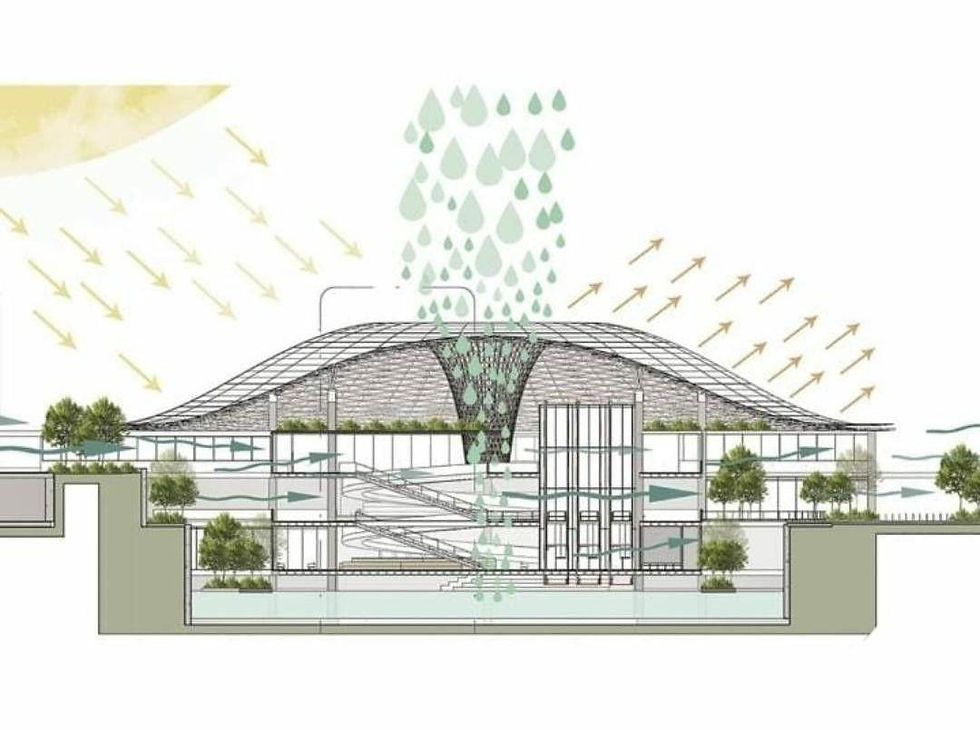

Ironically, many traditional architectural systems already understood ecological intelligence:
Persian wind catchers
Bangladeshi courtyards
Japanese spatial moderation
Thai passive ventilation
The problem is not lack of knowledge.The problem is that architecture became obsessed with mechanical dependency instead of environmental adaptation.
3. Attenborough’s Greatest Lesson: Scale Does Not Equal Intelligence
Nature rarely produces excess without purpose.
A forest is dense but balanced.A coral reef is complex but efficient.
Modern urbanism often mistakes scale for achievement.
The Result:
Megacities disconnected from ecology
Heat islands
Flood-prone urbanization
Psychological alienation


The most intelligent systems in nature are not the biggest.They are the most adaptive.
Architecture still struggles with this idea.
4. Art Understands Emotion Better Than Architecture
This is where Attenborough’s influence becomes deeply artistic.
His films do not persuade through statistics alone.They persuade through emotional connection.
He understood something architecture often forgets:
People protect what they emotionally value.
Modern architecture frequently becomes too technical, too abstract, too detached from sensory experience.
But nature communicates through:
Light
Sound
Texture
Rhythm
Seasonal change
The greatest architectural spaces do the same.
Think about the emotional power of:
Falling light in a mosque
Wind moving through a courtyard
Rain hitting a shaded veranda
Silence inside a forest-like space
These are not aesthetic accidents.They are environmental experiences.
Architecture should not merely shelter humans from nature.It should reconnect humans to it.
5. Biomimicry Is Not Style. It Is Survival Thinking.
One of the biggest mistakes in contemporary architecture is superficial biomimicry.
Copying the shape of a leaf does not make a building sustainable.
Nature’s intelligence lies in:
Material efficiency
Structural optimization
Adaptive systems
Zero-waste cycles


If architecture truly learned from nature, buildings would:
Consume less energy
Adapt to climate passively
Produce less waste
Age gracefully within ecosystems
The future of architecture is not futuristic aesthetics.It is ecological intelligence.
6. Attenborough at 100 Is a Mirror to the Design Industry
Celebrating David Attenborough while continuing destructive urban practices is intellectual hypocrisy.
You cannot admire nature in documentaries while designing cities that erase it.
That contradiction defines much of contemporary development.
The Real Challenge:
Architects must move beyond sustainability as branding.
The next generation of architecture must ask:
Does this building regenerate ecosystems?
Does it reduce dependency on mechanical systems?
Does it improve human psychological well-being?
Does it belong to its climate and geography?
If not, it is not future-ready architecture.
Conclusion
David Attenborough’s legacy is not wildlife filmmaking.It is ecological consciousness.
He spent a century teaching humanity that survival depends on understanding systems larger than ourselves.
Architecture now faces the same realization.
The future will not belong to buildings that dominate landscapes.It will belong to buildings that collaborate with them.
Nature is not a design reference.It is the most advanced design intelligence system ever created.
Architecture’s greatest challenge is not technological innovation.It is humility.
Call to Action
The future of architecture depends on whether design can reconnect with environmental intelligence instead of resisting it.
If you want to explore how ecological thinking, biomimicry, climate-responsive systems, and human-centered spatial design can shape the next generation of architecture—Graphite is building that bridge.
Connect with Graphite to move beyond image-driven architecture and toward design systems that perform with nature, not against it.


Comments