The Identity Crisis of Our Monuments: Is Architecture Becoming a Mere Replica?
- Gourav

- Feb 21
- 2 min read
Growing up in the 90s, the Shaheed Minar wasn't just a structure; it was a living stage. For those of us in Rajshahi, our identity was forged at the foot of the Bhubon Mohan Park Shaheed Minar or within the solemn curves of the Rajshahi University Shaheed Minar. We knew the "Central" Shaheed Minar primarily from the back of a 2-Taka note-a beautiful, maternal allegory of a mother protecting her fallen sons.

But as I traveled and studied the built environment, I realized that the strength of Bangladesh’s commemorative architecture lay in its regional diversity. From the rugged, context-driven designs at Chittagong University to the unique spatial stories told in Sylhet and Khulna, each monument spoke the "language" of its specific soil.

The Rise of the "Template" Monument (Identity crisis)
Recently, Rajshahi saw the opening of its own "Central" Shaheed Minar. While any new public space in our compact city is a welcome addition for urban breathing, a deeper question haunts the design:
Why is it a replica?

There was an initial buzz about a new, site-specific design and a dedicated budget. Yet, through the predictable churn of political and administrative shifts, the original vision was discarded in favor of a replica of the Dhaka Central Shaheed Minar.
This brings us to a critical architectural and cultural crossroads:
Narrative Erasure: Does this new structure tell the story of North Bengal’s martyrs? Or does it merely echo a story told 250 kilometers away?
The High Court Ruling vs. Artistic Freedom: In February 2023, a High Court rule suggested a uniform design for Shaheed Minars across the country. While intended to maintain "sanctity," from a design perspective, this is a death knell for regional identity. If every Minar looks the same, we aren't building monuments; we are installing logos.
Contextual Alienation: Architecture is supposed to be an extension of the land. A shimul tree in my backyard carries a specific weight of memory that a generic tree in a distant park cannot replicate.
Why Regionalism Matters
The reason we feel a "pull" toward our own neighborhoods-those small, perhaps unpolished corners of our hometowns-is because they reflect us. When we globalize or "centralize" our monuments, we rob the next generation of children in Rajshahi of the chance to see their own local history reflected in stone and concrete.
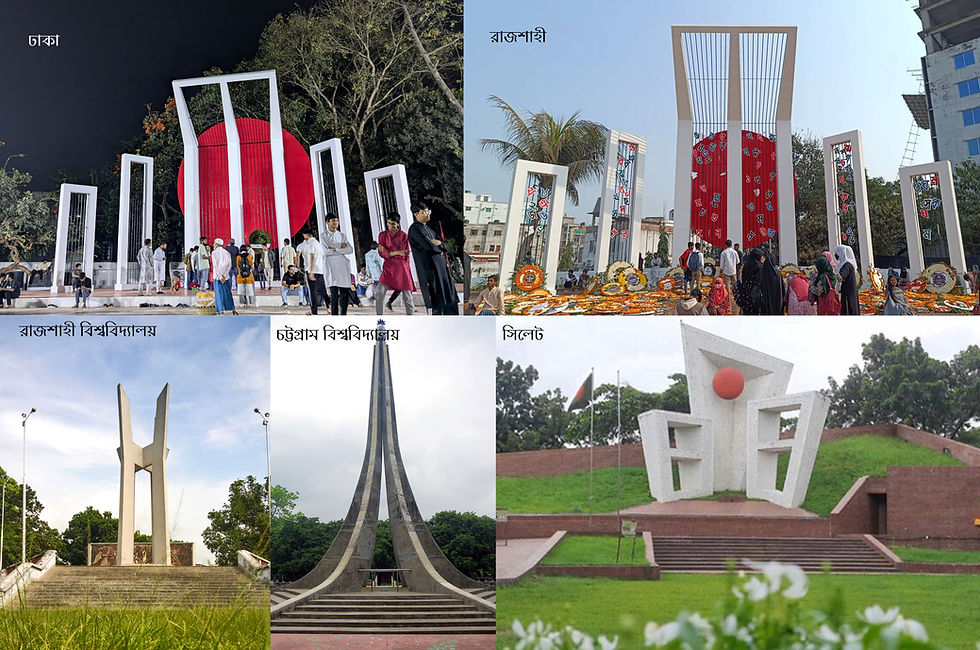
By opting for a replica, we have traded a unique emotional landmark for administrative convenience.
If the Shaheed Minar is a symbol of the right to speak one's own language, shouldn't the architecture itself be allowed to speak in the local dialect of its people?
Or are we destined to live in a country of architectural echoes, where the "Copy-Paste" command dictates our national identity (crisis) ?
References: 1. https://www.kalerkantho.com/print-edition/first-page/2023/02/05/1243401 2. https://www.wikiwand.com/en/articles/Shaheed_Minar,_Dhaka


Comments